Confidentiality is one of the cornerstones of the legal profession. Every client who hires an attorney expects that their personal information, legal strategy, financial records, and sensitive communications will remain protected. As more law firms embrace remote work and legal outsourcing, one question continues to arise: can confidential client information remain secure when handled by a virtual legal assistant? The answer is yes—provided that firms implement the proper security measures, technologies, and operational procedures.
Confidentiality Is a Professional Obligation
Every attorney has an ethical duty to protect client information. Whether administrative work is performed by an in-house employee or a remote professional, the responsibility for safeguarding confidential information remains the same.
Virtual legal assistants act as an extension of the legal team and should operate under the same standards of professionalism, discretion, and accountability expected from any employee within the firm. The focus should not be on where the work is performed but on how securely it is managed.
Secure Cloud-Based Systems Have Changed the Legal Industry
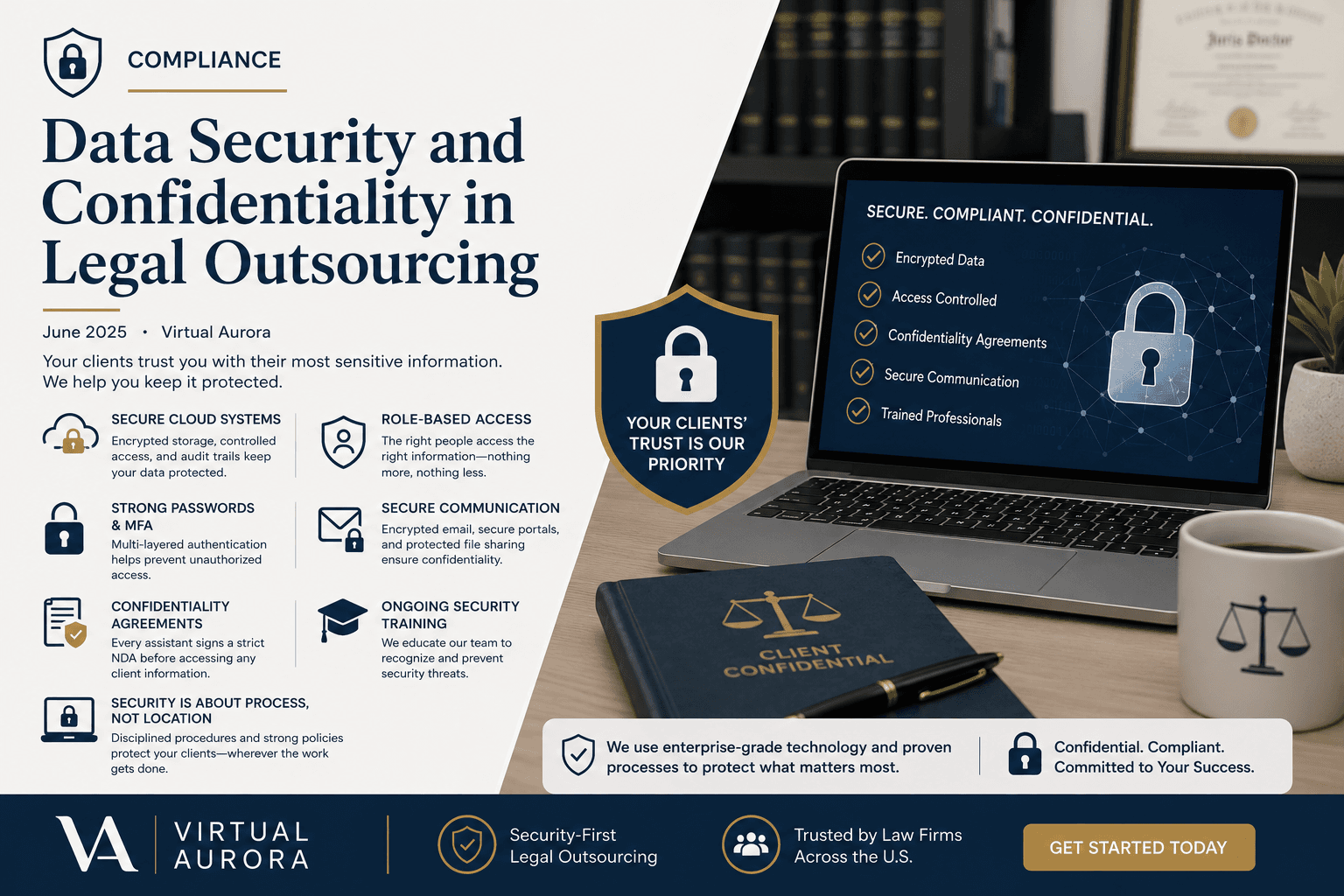
Today's law firms increasingly rely on cloud-based platforms for case management and document storage. Rather than storing files on local office computers, firms can maintain centralized, encrypted environments with controlled access permissions.
Authorized personnel can securely access information from any location while maintaining detailed activity logs and audit trails. Cloud-based legal operations often improve security by reducing dependence on physical files and decentralized storage methods.
Role-Based Access Protects Sensitive Information
One of the most effective security practices is implementing role-based permissions. Not every team member needs access to every file.
- Intake specialists access only prospective client information
- Administrative assistants manage scheduling and communications
- Case managers handle assigned files
- Attorneys retain access to privileged legal strategy documents
- Financial personnel manage billing information only
Strong Password Policies and Multi-Factor Authentication
Weak passwords remain one of the leading causes of security breaches. Every law firm should require complex passwords, password managers, regular password updates, multi-factor authentication (MFA), and secure login verification.
Even if login credentials are compromised, MFA provides an additional layer of protection that significantly reduces unauthorized access. For firms working with remote teams, enabling MFA across all business applications should be considered a standard security practice.
Secure Communication Matters
Legal professionals exchange confidential information every day through emails, messaging platforms, video conferences, and document-sharing systems. Secure communication requires encrypted email services, protected client portals, secure video conferencing platforms, access-controlled document sharing, and business communication tools instead of personal messaging apps.
Maintaining professional communication channels helps preserve confidentiality while ensuring efficient collaboration among attorneys and support staff.
Confidentiality Agreements Should Be Standard
Every virtual legal assistant should sign a comprehensive confidentiality agreement before accessing client information. These agreements typically include provisions regarding non-disclosure obligations, protection of client information, intellectual property, data handling procedures, confidential document management, and post-employment confidentiality requirements.
Ongoing Training Reduces Human Error
Technology alone cannot eliminate security risks. Human error remains one of the most common causes of data breaches. Regular security training helps virtual legal assistants recognize and avoid phishing emails, suspicious links, social engineering attempts, fraudulent login requests, and unauthorized file-sharing practices.
A well-trained remote team becomes one of the firm's strongest defenses against cyber threats.
Data Security Is About Processes, Not Physical Location
Many firms assume that employees working inside an office are inherently more secure. However, data breaches occur in traditional offices every year due to lost laptops, unlocked computers, shared passwords, misplaced paper files, unauthorized USB devices, and internal negligence.
Security depends on disciplined procedures rather than physical proximity. A remote professional following strict security protocols may actually present less risk than an employee operating in an unsecured office environment.
Security-First Legal Outsourcing
Our Virtual Legal Assistants operate under strict confidentiality agreements, secure technology platforms, and data protection protocols designed specifically for U.S. law firms.
Modernize your operations without compromising client trust.
Get Started Today