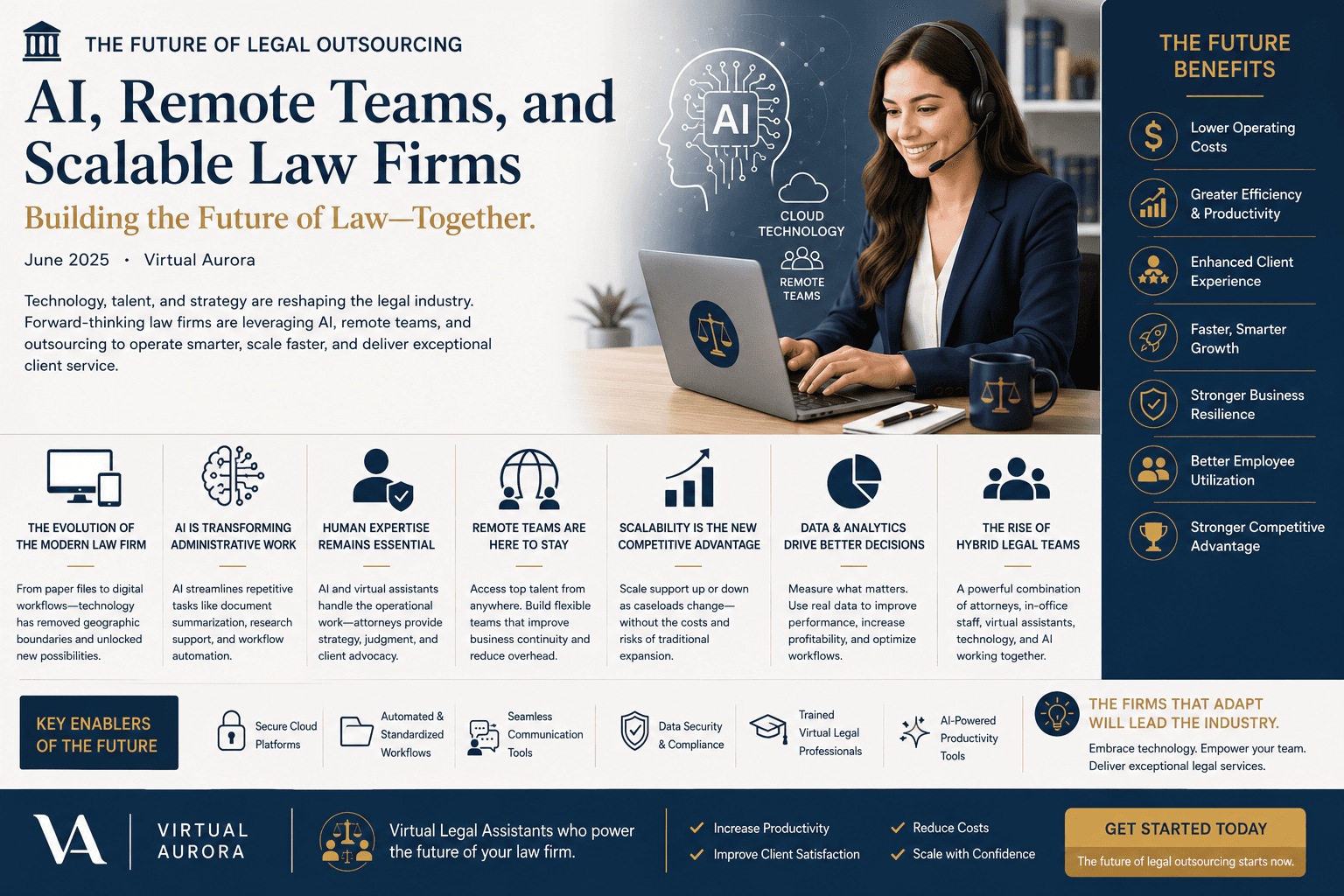
The legal industry is experiencing one of the most significant transformations in its history. Advances in artificial intelligence, cloud technology, and remote collaboration are reshaping how law firms operate, serve clients, and compete in an increasingly digital marketplace. Legal outsourcing has become a key component of this transformation. Combined with artificial intelligence and remote work, it enables firms to operate more efficiently, reduce costs, and scale without the limitations of traditional business models.
The Evolution of the Modern Law Firm
Law firms have gradually shifted from paper-based operations to fully digital workflows. Electronic signatures, cloud-based case management systems, virtual meetings, online client portals, and digital document storage have become standard tools across the legal profession.
As technology continues to evolve, location is becoming less important than expertise, responsiveness, and operational efficiency.
Artificial Intelligence Is Changing Administrative Work
Artificial intelligence is rapidly transforming routine administrative tasks within law firms. Modern AI tools can assist with document summarization, legal research support, email drafting, appointment scheduling, data organization, meeting transcription, workflow automation, document classification, and internal knowledge management.
These technologies reduce repetitive work and allow legal professionals to dedicate more time to strategic decision-making and client advocacy. However, AI is most effective when combined with human judgment and oversight.
Human Expertise Remains Essential
Despite rapid technological advancements, the legal profession continues to rely on critical thinking, ethical judgment, empathy, and professional discretion. Clients seek legal representation during some of the most important moments of their lives. They value personalized guidance, strategic advice, and human understanding—qualities that technology cannot replace.
Virtual legal assistants complement AI by managing workflows, communicating with clients, organizing information, and ensuring that automated processes remain accurate and effective. The future is not about replacing people with technology but empowering people through technology.
Remote Teams Have Become a Permanent Business Model
The global shift toward remote work demonstrated that highly effective teams do not require a shared physical office. Today, law firms successfully manage distributed teams across multiple cities, states, and even countries.
Remote collaboration offers numerous advantages: access to broader talent pools, increased flexibility, reduced overhead costs, business continuity, faster scalability, improved employee satisfaction, and enhanced operational resilience.
Scalability Is the New Competitive Advantage
Growth has traditionally required larger offices, more equipment, and significant hiring investments. Modern firms can now scale more strategically by leveraging remote professionals and digital infrastructure.
Virtual legal assistants enable firms to expand administrative capacity without the fixed costs associated with traditional expansion. Scalable operations also reduce financial risk during periods of fluctuating workload.
Data and Analytics Will Drive Better Decisions
The law firms of the future will rely more heavily on operational data to improve performance. Metrics such as client response times, intake conversion rates, case processing speed, administrative workload, client satisfaction, referral rates, staff productivity, and workflow completion times will provide valuable insights.
Virtual legal assistants contribute by maintaining organized systems and ensuring that information is captured accurately and consistently. Data-driven management enables smarter business decisions and continuous optimization.
The Rise of Hybrid Legal Teams
Rather than choosing between traditional employees and remote professionals, many firms are adopting hybrid staffing models that combine attorneys, paralegals, in-office administrative staff, virtual legal assistants, technology specialists, and AI-powered productivity tools.
This balanced approach allows firms to optimize resources while maintaining flexibility and exceptional client service. Hybrid teams represent one of the most practical and sustainable models for future growth.
The Firms That Adapt Will Lead the Industry
Law firms that embrace AI, remote collaboration, and strategic outsourcing will benefit from lower operating costs, greater efficiency, faster growth, enhanced client experiences, increased profitability, better employee utilization, and stronger competitive positioning.
The future of legal services will be defined by how effectively firms combine technology with talented professionals and efficient operational systems. Attorneys will focus on strategy, advocacy, negotiation, and legal expertise—while AI and virtual assistants handle the rest.
Position Your Firm for the Future
Our Virtual Legal Assistants are trained to work alongside your technology stack—helping your firm operate at the cutting edge of efficiency while maintaining the personal touch your clients expect.
The future of legal outsourcing starts now.
Get Started Today